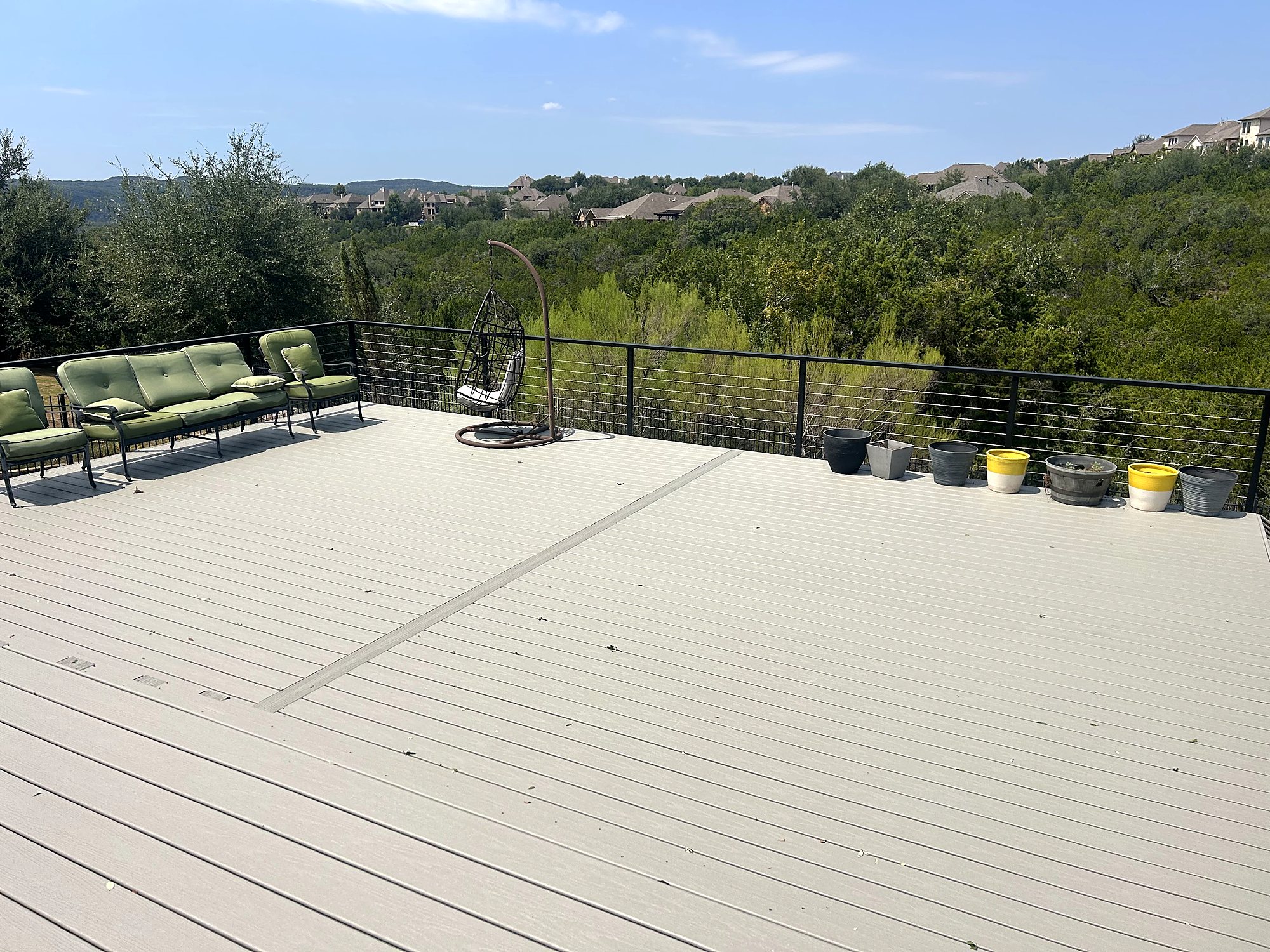
There is no flat price for a new deck in Austin, because the deck cost depends on a handful of decisions: how big and how high it is, what it is built from, and what your yard is like. Understand those factors and you can read any quote with confidence, compare bids fairly, and see where you can save without cutting corners.
Below we walk through each factor, share the one published local benchmark worth knowing, and explain how to get a number you can actually budget around.
What Published Data Says About Deck Cost in Austin
Most “average price” figures online are national guesses. One exception is the 2025 Cost vs. Value Report from the Journal of Light Construction, which prices the same projects in 119 U.S. markets, Austin included.
Its benchmark is a 16-by-20-foot deck on pressure-treated joists and concrete piers, with three steps to grade, a built-in bench and planter, and a full railing system. For Austin, the 2025 report lists:
- Wood deck addition: $14,807 average job cost, with 93.9% of that cost recouped at resale.
- Composite deck addition: $22,613 average job cost, with 85.8% recouped at resale.
The national averages for the same two projects were $18,263 and $25,096. Treat these figures as reference points, not quotes. Your deck will be a different size, height and design, and every factor below moves the number up or down.
Size, Height and What Sits Underneath
Square footage is the obvious driver. More deck means more framing, more boards and more labor. But price does not scale perfectly with size: design, permitting and setup costs are spread over more area on a bigger deck, so doubling the footprint rarely doubles the total.
Height above grade
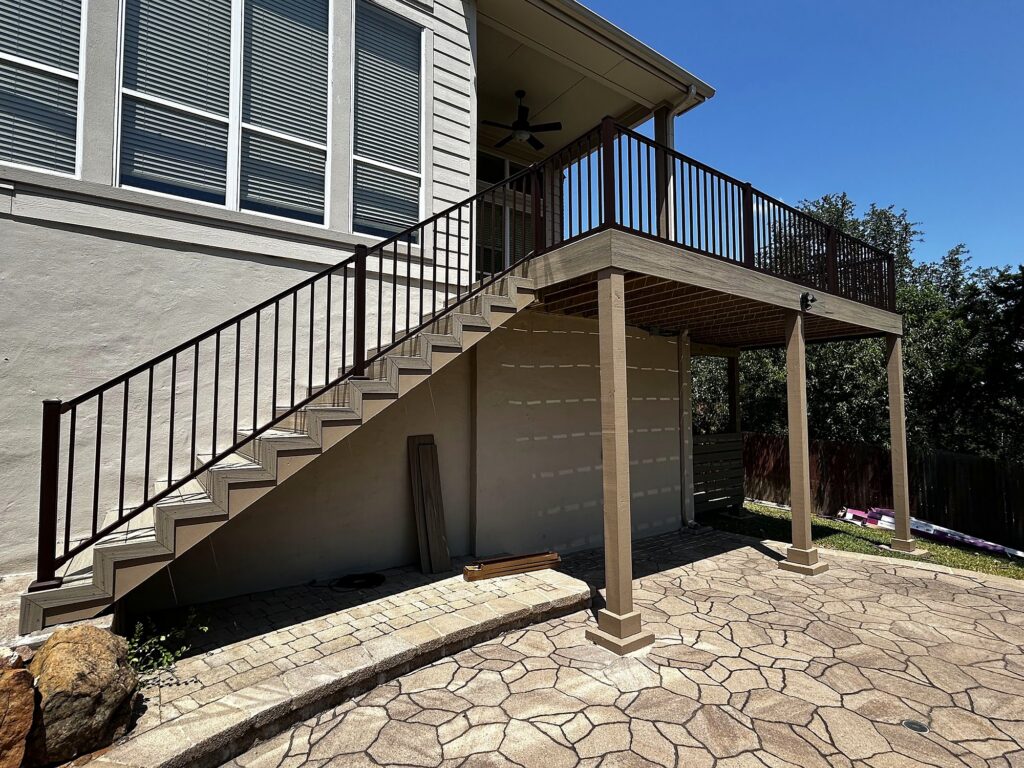
Height matters as much as footprint. A low deck a step or two off the ground needs short posts and little bracing. A second-story or multi-level deck needs taller posts, heavier beams, lateral bracing, longer stair runs and guardrails around the open edges, and the crew spends more of the job on ladders and scaffolding.
Footings and framing
Every deck rests on footings, usually concrete piers, and their number and depth depend on the deck’s size, height and load. Austin soil adds a local twist. On many west-side lots, limestone sits close to the surface and has to be drilled or broken to set piers. East of I-35, clay soils that swell and shrink with moisture call for careful footing design.
Framing is typically pressure-treated lumber, even under composite boards. Planning a hot tub, outdoor kitchen or heavy planters means stronger framing, which adds material and labor.
Decking Material: The Biggest Single Choice
Once the size and height are set, the decking material moves your deck cost in Austin more than anything else. Here is how the main options compare:
| Decking | Upfront cost | Ongoing upkeep | Notes |
|---|---|---|---|
| Pressure-treated pine | Lowest | Regular cleaning plus periodic stain or sealer | Most budget-friendly; grays and checks without upkeep |
| Cedar | Moderate | Regular cleaning plus periodic stain or sealer | Warm natural look; softer than pine |
| Trex Enhance | Entry-level composite | Soap-and-water cleaning | 25-year limited residential fade and stain warranty |
| Trex Select | Mid-range composite | Soap-and-water cleaning | 35-year limited residential fade and stain warranty |
| Trex Transcend | Premium composite | Soap-and-water cleaning | 50-year limited residential warranty |
Composite costs more on day one, but it skips the staining and sealing that wood needs every few years, so the gap narrows over the life of the deck. Smaller choices add up too: board color, grooved boards with hidden fasteners versus face screws, and picture-frame borders all affect the final figure. Our overview of Trex decking lines covers colors and finishes in more detail.
Railings, Stairs and Deck Shape
Railings are often a bigger share of the budget than people expect. They are priced by the linear foot, and a raised deck can need railing on three sides.
- Wood railings are the most economical and can be painted or stained to match.
- Composite railings pair with composite decking and never need painting.
- Aluminum railings are slim, strong and low-maintenance.
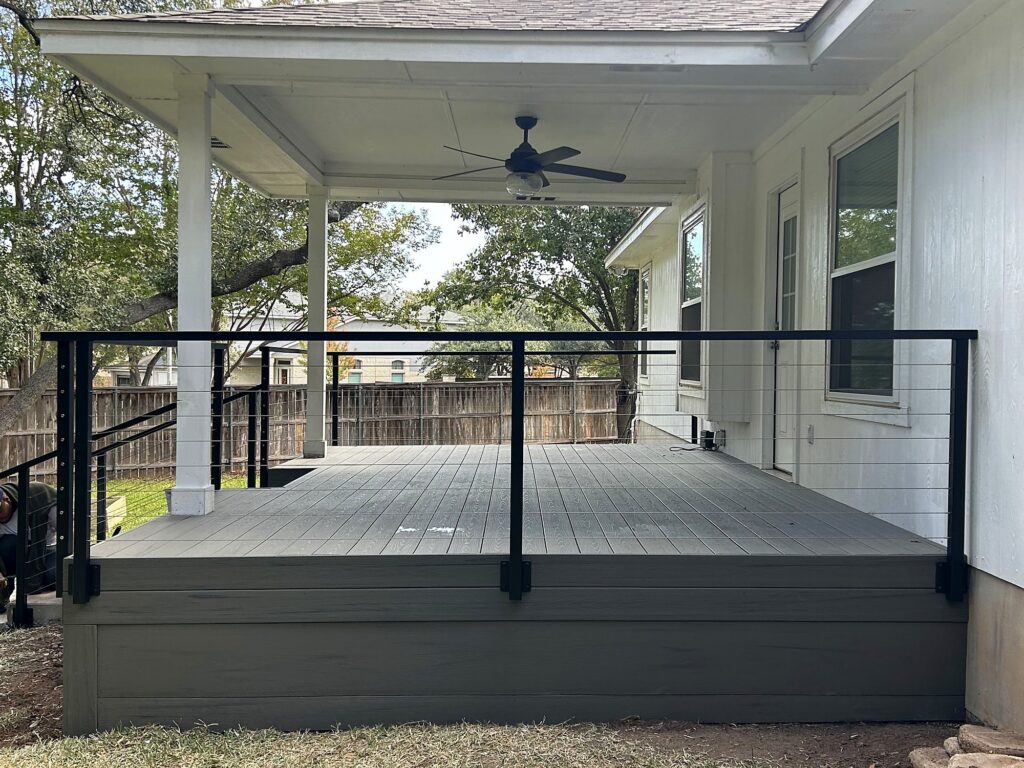
- Cable railings keep the view open but take more hardware and labor to install and tension correctly.
Stairs add cost per step, plus landings on taller runs and railings on both sides. Wide, flared deck stairs look great but use more material than a single straight run.
Shape counts as well. A simple rectangle is the most efficient deck to build. Angled corners, curves, inlays, borders and multiple levels all add cutting, blocking and labor time, even when the square footage stays the same.
Site Access, Slope, Permits and Demolition
Your yard is part of the price, and some of these factors only show up when a contractor walks the property.
Access and slope
When materials can roll straight into the backyard, the job moves faster. Narrow side yards, small gates, steep grades, retaining walls and mature trees mean more carrying by hand and more careful layout. Hill Country lots often slope enough that one edge of the deck sits at ground level while the other is several feet up, which brings taller posts and more railing into play.
Permits and inspections
Plan on a permit for most new decks. The City of Austin’s list of work exempt from building permits covers only a deck that is no more than 200 square feet, no more than 30 inches above grade at any point, not attached to the house, not providing egress from the house, and not in a flood hazard area. Exempt or not, the work still has to meet code.
Permit fees, drawings and inspections belong in the budget, and an HOA review can add a step. Cities such as Round Rock, Cedar Park and Georgetown set their own requirements, so check with the local building department or the City of Austin Development Services Department before you finalize plans.
Removing an old deck
Replacing a worn-out deck means tearing it out and hauling it away first, which adds labor and disposal. If the existing framing is sound, putting new boards on the old structure can cost less than a full rebuild, but that call should come only after someone inspects the joists, beams and footings.
Add-Ons That Change the Number
Extras are where a deck becomes an outdoor room, and where budgets stretch. Common add-ons include:
- Lighting: post-cap, stair-riser and under-rail lights make the deck usable after dark and safer on the steps.
- Skirting: closes off the space under the deck for a finished look and helps keep animals out.
- Shade: a pergola, louvered pergola or solid patio cover makes a west-facing deck usable on summer afternoons.
- Built-ins: benches, planters and privacy screens.
- Pool and hot-tub features: reinforced framing, drainage and slip-resistant surfaces.
You do not have to build everything at once. Running wiring or setting footings for a future cover during the initial build can save rework later.
How to Get an Accurate Deck Quote
A reliable deck cost in Austin comes from your actual site, not a web calculator. To get one:
- Decide how you will use the deck. Grilling, dining for eight or a hot tub each point to a different size and layout.
- Get an on-site visit. Slope, soil, access and how the deck ties into your house all affect the price, and none of them show up in a photo.
- Compare line items, not just totals. Make sure each bid names the same decking line, railing type, footing approach and fastening method.
- Ask who handles the permit and whether drawings and inspections are included.
- Ask about warranties on both materials and workmanship.
- Find out who runs the job day to day, so you have one point of contact.
Green Hill Remodeling offers free on-site estimates, and every project gets a dedicated project manager. After more than 15 years of building custom decks in Austin, we can show you quickly where your design is spending money and where it does not need to.
Paying for Your New Deck
Many homeowners would rather not pay for a deck in one lump sum. Financing with 0% down is available, which can make it easier to choose the material you actually want, such as composite over wood, instead of the one that fits this month’s budget. See our deck financing options for current details.
Ready to put a real number on your deck? Request a free on-site estimate or call (737) 529-4322. We will measure your yard, walk through materials and design options, and give you a clear price for the deck you want.
Frequently Asked Questions
Usually, yes. Within Austin city limits, a deck skips the building permit only if it is 200 square feet or smaller, no more than 30 inches above grade, freestanding, not used as an exit from the house, and outside a flood hazard area. Attached decks and most larger projects need plan review and inspections. Surrounding cities have their own rules, so confirm with the local building department.
It often is if you plan to stay in your home for years. Composite costs more upfront, but it does not need staining or sealing, resists fading in strong sun, and holds up well around pools. If budget is tight or you may move soon, a well-built pressure-treated or cedar deck can be the smarter buy. Comparing both in one estimate makes the decision easier.
Keep it low, rectangular and on a single level, use pressure-treated pine with wood railings, and choose one straight set of stairs. A yard with easy access for materials also helps. You can add lighting, skirting or shade later, as long as wiring and footings are planned during the first build so nothing has to be torn out.
Sometimes. If the joists, beams and footings are still solid and spaced correctly for the new boards, replacing only the decking and railings can cost noticeably less than a full rebuild. Rot, sagging, loose ledger connections or undersized framing usually mean the structure needs to be rebuilt. An on-site inspection is the only reliable way to tell which you need.
Start planning a few months before you want to use it. Design, material selection and permit review all take time, so homeowners who want a finished deck for summer cookouts or pool season do best by getting estimates in winter or early spring. Fall's milder weather also makes it a comfortable season to build and to enjoy a new deck right away.