Deck Stairs & Stair Railings in Austin, TX

Home/Services/Deck Railings/Deck Stairs & Stair Railings

Quick Answer

Green Hill Remodeling builds deck stairs and stair railings across Austin, from long composite runs off second-story decks to wide wood steps made for sitting. We follow IRC rise-and-run limits, typically 7-3/4 in. maximum risers and 10 in. minimum treads, add landings where needed, and install graspable handrails and step lighting. Call (737) 529-4322 for a free estimate.

Deck Stairs in Austin

Stairs That Feel Right on Every Step

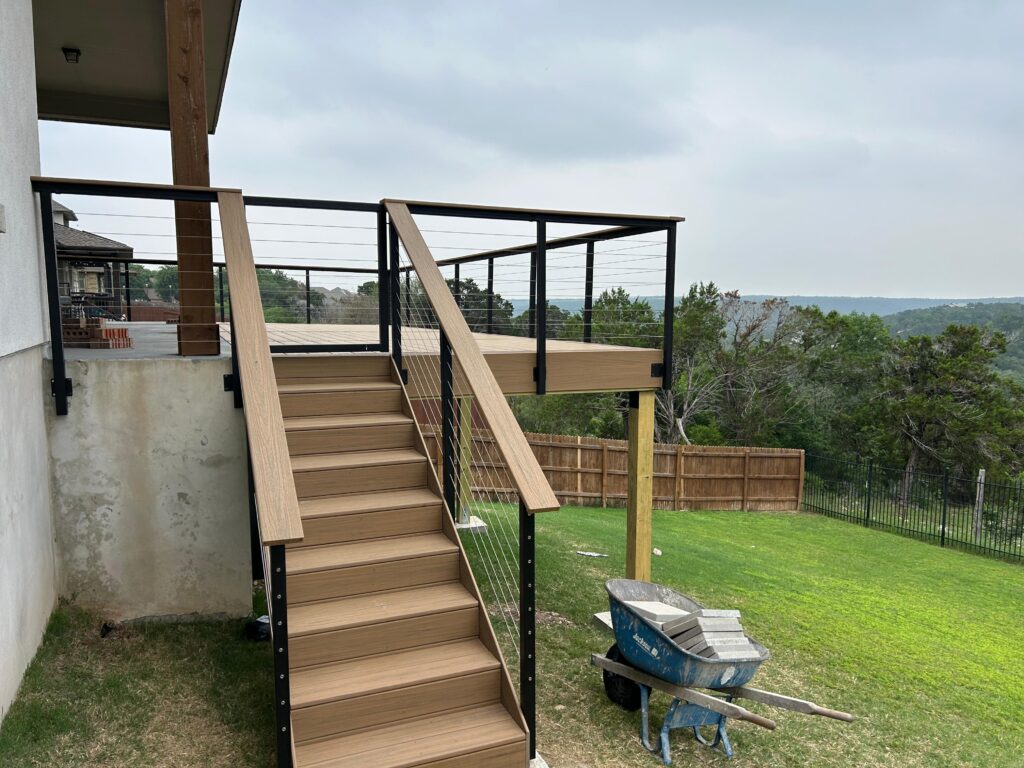
Stairs are the part of a deck people touch every day, and they're where shortcuts show first. A riser that's half an inch taller than the rest, a stringer that flexes underfoot or a handrail you can't wrap your hand around turns a nice deck into a trip hazard. Our stair work ranges from long composite flights coming down from second-story decks to broad, low wood steps that double as extra seating along the yard.

Good stairs start with math. We measure total rise from the deck surface to the ground or landing below, divide it into equal risers within IRC limits, and set tread depth so the stride feels natural. Then the structure has to match: stringers sized and spaced for the tread material, a solid footing or pad at the bottom, and a top connection that won't pull away from the rim joist.

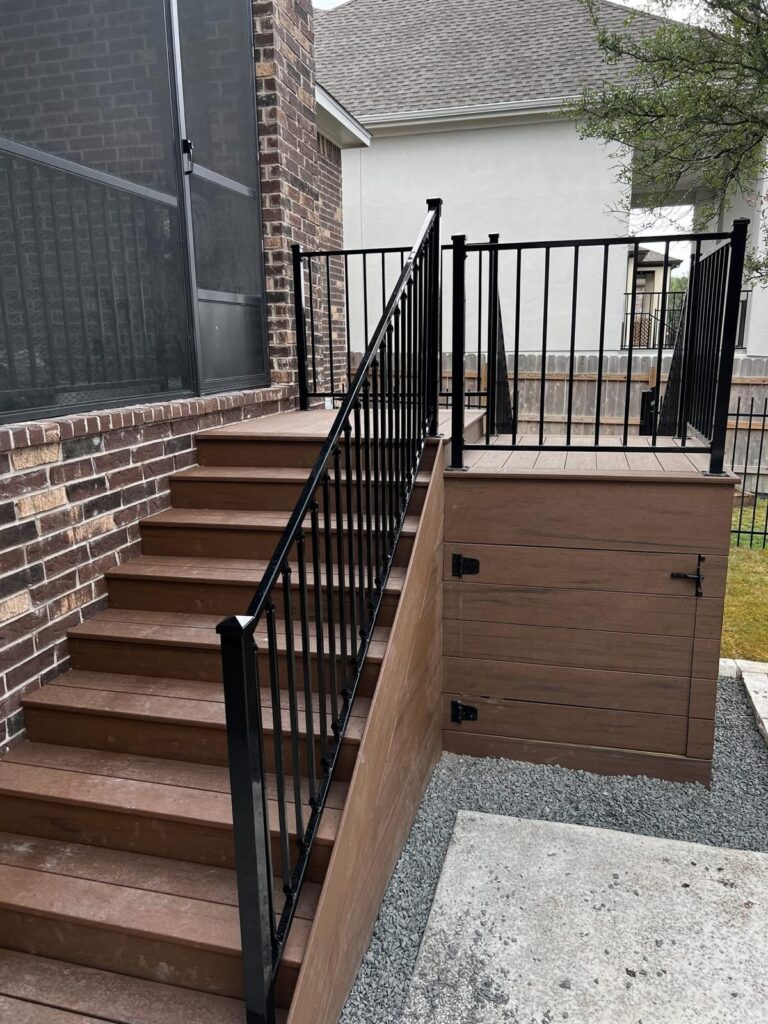
Railings and light complete the job. Stairs with four or more risers typically need a graspable handrail, and open sides more than 30 in. above grade need guards. We install those in wood, composite or black aluminum to match the deck, then add low-voltage riser or post-cap lights so each step reads clearly after dark. Every stair project gets a dedicated project manager and licensed, insured crews with 15+ years of Central Texas experience.
15+Years Building
5★Rated Service
100%Licensed & Insured
Outdoor living space built by Green Hill Remodeling in Austin, TX

Why It Matters

What Well-Built Deck Stairs Give You

A stair is a small structure with big consequences. These are the details we never compromise on.

Consistent rise and run

Every riser in a flight is cut to nearly the same height, within the 3/8-in. variation the IRC typically allows, so nobody catches a toe.

Wide, comfortable treads

We size tread depth and stair width for real use: carrying coolers, walking kids down at night or hosting a crowd on wide entertaining steps.

Stiff, quiet stringers

Stringers are spaced for your tread material, and composite often needs closer spacing, so steps don't bounce, flex or creak under weight.

Graspable handrails

Handrails mounted typically 34 to 38 in. above the tread nosings, with a profile your hand can actually wrap around, not just a flat board.

Lit for nighttime

Low-voltage riser, tread and post-cap lights mark each step after dark without glare, which makes long stair runs far safer to use at night.

Matched to your deck

Treads, risers, fascia and railings match the deck's composite or wood, so the stairs look built in rather than added on later.

Stair Options

Deck Stair Layouts, Materials and Railings

From a single step down to the lawn to a two-story flight with a landing, here's what we build.

Long stairs from second-story decks

Tall decks often need a flight with a landing partway down, or a switchback layout to fit the yard. We plan the run so the bottom step lands where it makes sense for foot traffic and drainage.

Wide entertaining steps

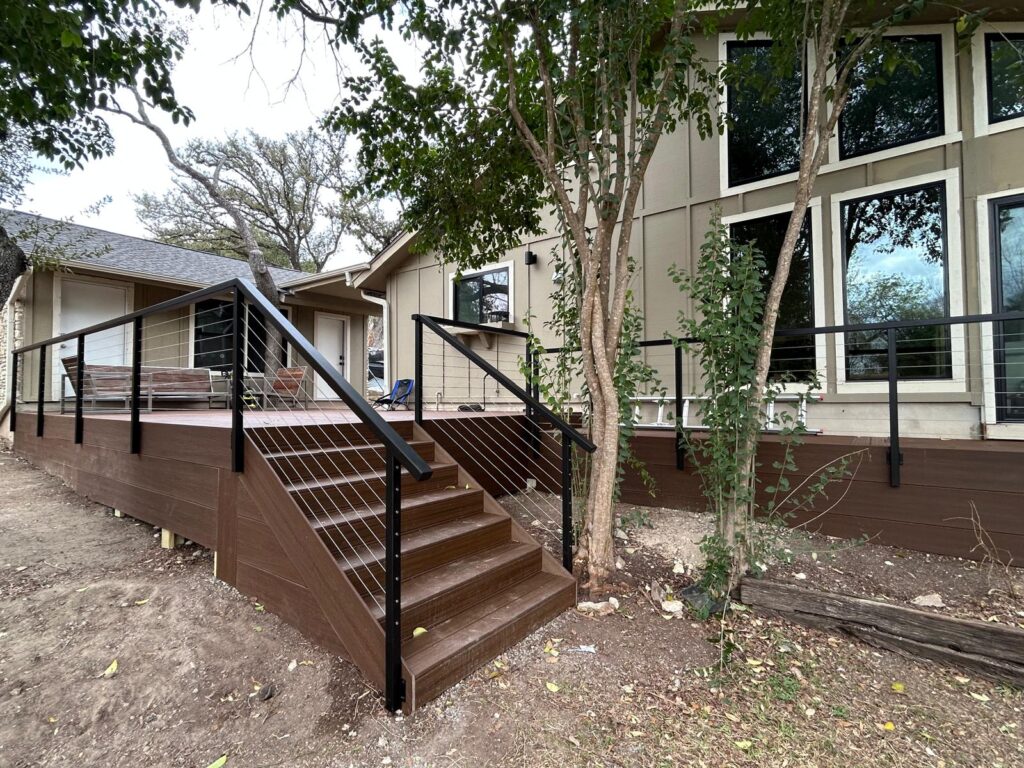
Broad, low steps running much of the length of a deck work as seating, a gentle transition to the lawn and a ledge for planters. They're especially popular on ground-level decks and pool decks.

Composite stair treads

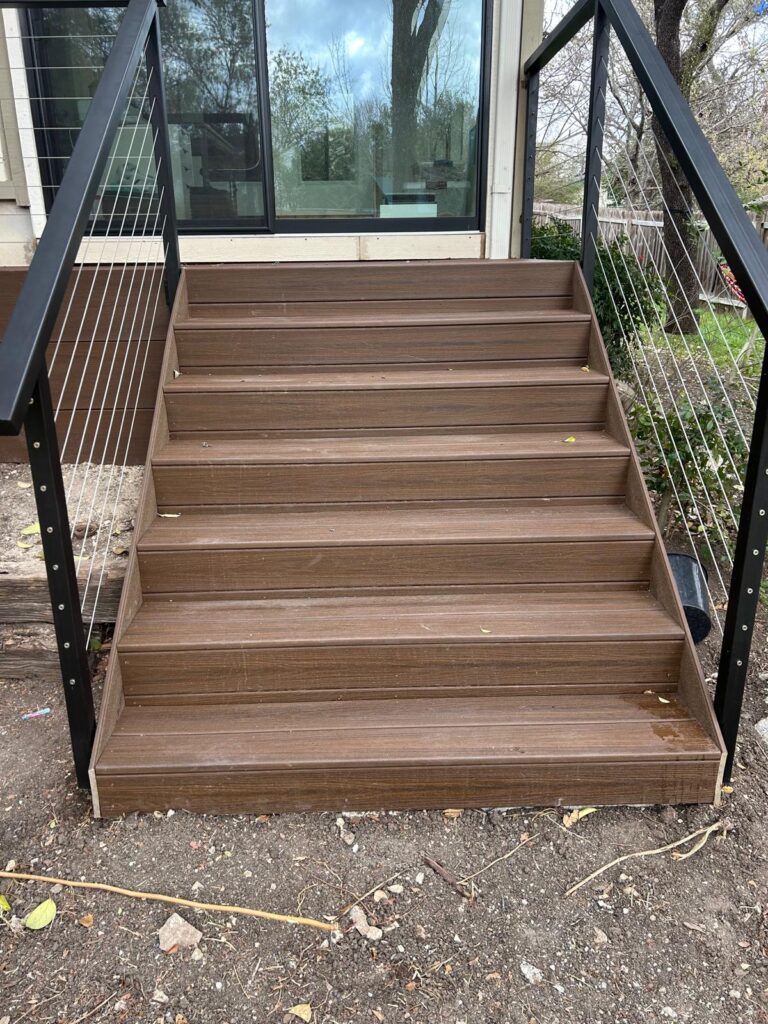
Composite treads from lines like Trex Transcend, Enhance and Select resist splintering and rot. They require tighter stringer spacing than wood, per the manufacturer, and we finish edges with matching fascia on the risers.

Cedar and pressure-treated steps

Cedar gives a warm, natural look, and pressure-treated pine makes a sturdy, practical structure. Wood treads need adequate thickness or support to stay stiff, plus periodic sealing to hold up under Texas sun.

Metal stair railings

Black aluminum picket or cable-infill stair railings are racked to the stair angle, with an add-on round handrail where needed for grip. They match the deck guard for a continuous look from top to bottom.

Step and riser lighting

Recessed riser lights, under-tread strip lights or post-cap lights run on low-voltage transformers with timers or photocells. We plan wiring during framing so nothing ends up surface-run later.

Recent Green Hill Projects
Custom deck installation in Austin, TX by Green Hill Remodeling
Backyard deck project by Green Hill Remodeling, Austin TX
Custom deck installation in Austin, TX by Green Hill Remodeling

How We Build Them

Our Deck Stair Building Process

Stairs get their own design pass on every project, not a leftover hour at the end of the deck build.

Measure rise and plan the run

We measure total rise, check the landing area and slope, and lay out equal risers and treads that fit both the IRC and your yard.

Footings, landing and stringers

We set a stable footing or pad at the base, cut stringers to the layout, and secure them to the deck framing with rated connectors.

Treads, risers and railings

Treads and risers go on in your chosen material, then guards and graspable handrails are installed and checked for height and rigidity.

Lighting and final walk-down

We wire and test the step lights, re-check every riser for consistency, and walk the stairs with you to confirm they feel right underfoot.

Built for Central Texas

Deck Stairs Designed for Austin Terrain

Austin's terrain makes stairs trickier than they look. On Hill Country lots in Dripping Springs, Lakeway or west Austin, the ground below a deck often slopes or steps down over limestone, so the bottom of a stair may land on rock in one spot and soil in another. East of MoPac and out in Pflugerville or Hutto, expansive clay swells and shrinks with rain and drought, which can heave a bottom landing out of level if it isn't built for it.

We design the base of every stair for its actual soil and slope, so riser heights stay consistent long after install. Treads are gapped to shed sudden downpours, and we keep stringers up off wet ground to discourage rot and termites. For tall second-story stairs, we plan landings where the IRC typically requires them and route the layout around live oaks and their roots instead of through them, which also keeps leaf litter off the steps.

  • Risers no taller than 7-3/4 in., typically per the IRC
  • Treads at least 10 in. deep, measured nosing to nosing
  • Graspable handrail on stairs with four or more risers
  • Guards on open sides more than 30 in. above grade
  • Stringer spacing matched to composite or wood tread specs
  • Low-voltage step lighting planned before the treads go on

FAQ

Deck Stairs & Stair Railings Questions, Answered

What are the code requirements for deck stairs in Austin?

Austin adopts the IRC with local amendments. Typically, that means risers no taller than 7-3/4 in., treads at least 10 in. deep, a stair width of at least 36 in., and a graspable handrail 34 to 38 in. high on stairs with four or more risers. Open sides more than 30 in. above grade need guards. We build to the adopted code and guide you through permitting where it's required.

Do my deck stairs need a landing?

Typically yes at the bottom, and the deck itself usually serves as the top landing. The bottom landing should be firm and level, not loose soil or mulch. Very tall flights off second-story decks may also need an intermediate landing, since the IRC limits how much height a single run can climb. Landings also let us turn the stairs to fit a narrow yard.

Why do some deck stairs feel bouncy?

Bounce usually comes from stringers spaced too far apart for the tread material, undersized stringers or a weak connection at the top. Composite treads are less stiff than wood and typically need stringers closer together, often around 12 in. on center depending on the manufacturer. We follow the decking maker's stair spacing and add stringers or blocking on wider stairs.

Can you add lighting to existing deck stairs?

Usually, yes. Post-cap lights and surface-mounted riser lights can often be added with minimal disruption, and low-voltage wiring can be routed under the stairs to a transformer. Recessed riser lights are easiest to install while treads and risers are off, so if you're rebuilding the stairs anyway, that's the best time to add them.

How wide should deck stairs be?

The IRC typically calls for at least 36 in. of clear width, but that's a minimum. For main stairs that carry guests, groceries and pool gear, many homeowners prefer 4 ft or wider. Wide entertaining steps can run much of a deck's length. We size width around how you'll actually use the stairs and how the railing affects the clear space.

Can you replace just my stairs without rebuilding the deck?

Often. If the deck framing is sound, we can tear out worn or out-of-code stairs and build new ones with fresh stringers, treads, railings and lighting. We inspect the rim joist where the stairs attach first, since rot or termite damage there needs repair. We'll also match materials as closely as possible to the existing deck.

Get Started

Let's Build Stairs You'll Trust Every Day

Book a free on-site estimate and design consultation. We'll measure your rise, talk through layout, railings and lighting, and explain what code requires. Call (737) 529-4322.

✓ Free on-site estimatesLicensed & insured15+ years in Central Texas(737) 529-4322View all services →