Home/Services/Composite Decking/Composite Deck Resurfacing
Composite deck resurfacing replaces worn wood decking with composite boards while keeping the existing frame, as long as the joists, beams, posts and footings are still sound. Green Hill Remodeling inspects every joist, corrects spacing for composite, adds joist tape, and installs hidden fasteners and picture-frame borders. For a free on-site evaluation in Austin, call (737) 529-4322.
Re-Decking Over Your Existing Frame
Plenty of Austin decks were framed well and simply wore out on top. Pressure-treated boards split, cup and turn gray after a few summers of 100-degree heat and hard UV, while the joists underneath stay dry enough to keep doing their job. Resurfacing takes advantage of that: we strip the old decking and railings, keep the structure that still passes inspection, and lay composite boards across it. You get a low-maintenance surface without paying to rebuild framing that isn't broken.
The catch is that composite isn't wood, and a frame built for wood boards doesn't always suit it. Composite is heavier and more flexible, so most manufacturers want joists closer together than many older decks were built. Fastener systems, board gaps and expansion allowances differ too. That is why every resurfacing job here starts with a hands-on framing inspection rather than a quote based on square footage alone. If the frame needs help, you will know exactly where and why before any work begins.
We resurface decks across Austin and the surrounding area, from shaded backyards under live oaks to raised decks on Hill Country slopes in Lakeway and Dripping Springs. Our crews install Trex Transcend, Enhance and Select boards, among others, and a dedicated project manager keeps the job on track from demo through the final walk-through. Licensed, insured and backed by 15+ years of building decks in Central Texas, we treat a resurfacing job with the same care as a new build.
Why Resurface With Composite
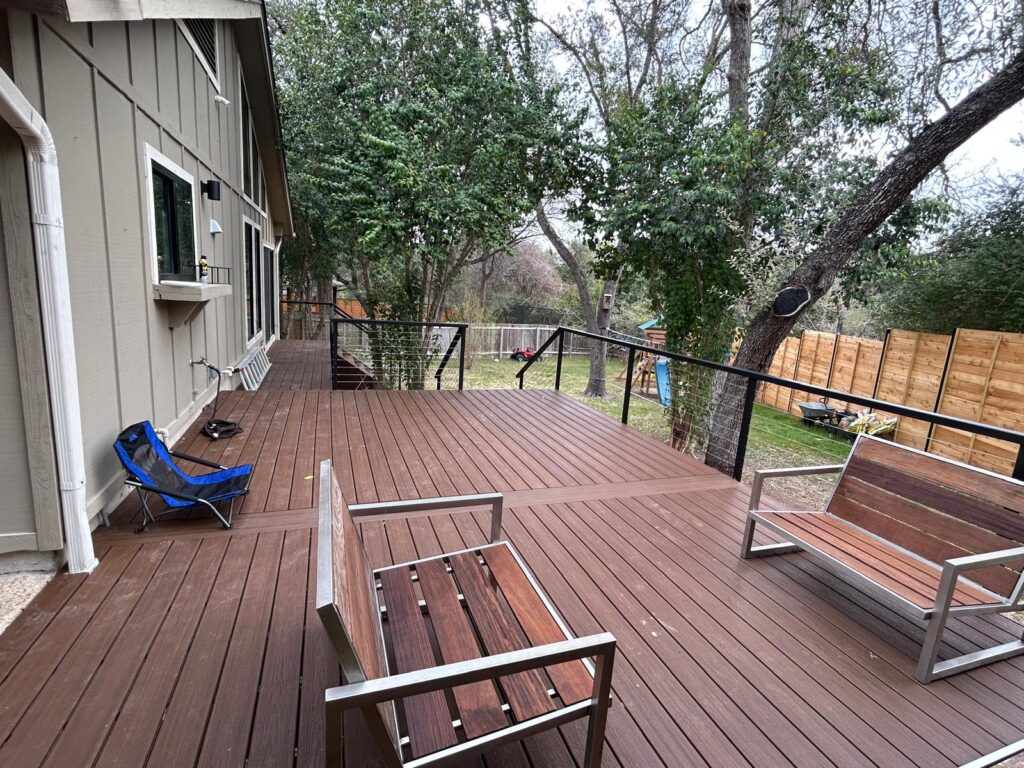
Keeping a sound frame and replacing only the surface that wears out is the most efficient path to a composite deck, provided the structure qualifies.
When joists, beams and footings pass inspection, keeping them avoids the cost and disruption of a full rebuild while still delivering a brand-new walking surface.
Capped composite boards resist fading, splintering and cupping under intense UV far better than bare wood, so the surface holds its look summer after summer.
No more sanding, staining or sealing every couple of years. Composite needs occasional soap-and-water cleaning to stay sharp under oak leaves and spring pollen.
Hidden clip fasteners hold grooved boards from the side, leaving a smooth surface with no screw heads to catch bare feet or collect dirt.
Picture-frame borders wrap the perimeter and stair edges, hiding cut board ends and giving a resurfaced deck the tailored look of a custom build.
Butyl joist tape over every joist and beam top sheds water away from fastener holes, helping the reused framing keep pace with the new boards.
What's Included
Every re-decking project is scoped after inspection. These are the pieces most Austin homeowners choose from.
We probe joists, beams, posts and ledger connections for rot, termite damage and loose hardware, then sister or replace individual members that fail. Repairs are itemized so you see exactly what the frame needs.
Older decks were often framed at 24 inches on center. Most composite lines typically call for 16 inches on straight runs and 12 inches for diagonal layouts, so we add joists wherever the manufacturer requires.
Butyl tape goes over the tops of joists and beams, and the ledger is checked for proper flashing and attachment against the house. Both steps keep water away from the wood you are reusing.
Grooved-edge boards are secured with concealed clips that set consistent gaps for drainage and expansion. Square-edge boards at borders and stairs are face-fastened with color-matched screws or plugs for a clean finish.
A matching or contrasting border around the perimeter hides board ends, and a breaker board can split long runs. Both require added blocking, which we install while the frame is open.
Resurfacing is a natural time to replace tired wood railings with composite, aluminum or cable, and to re-tread stairs in composite while checking riser and tread dimensions against the IRC.
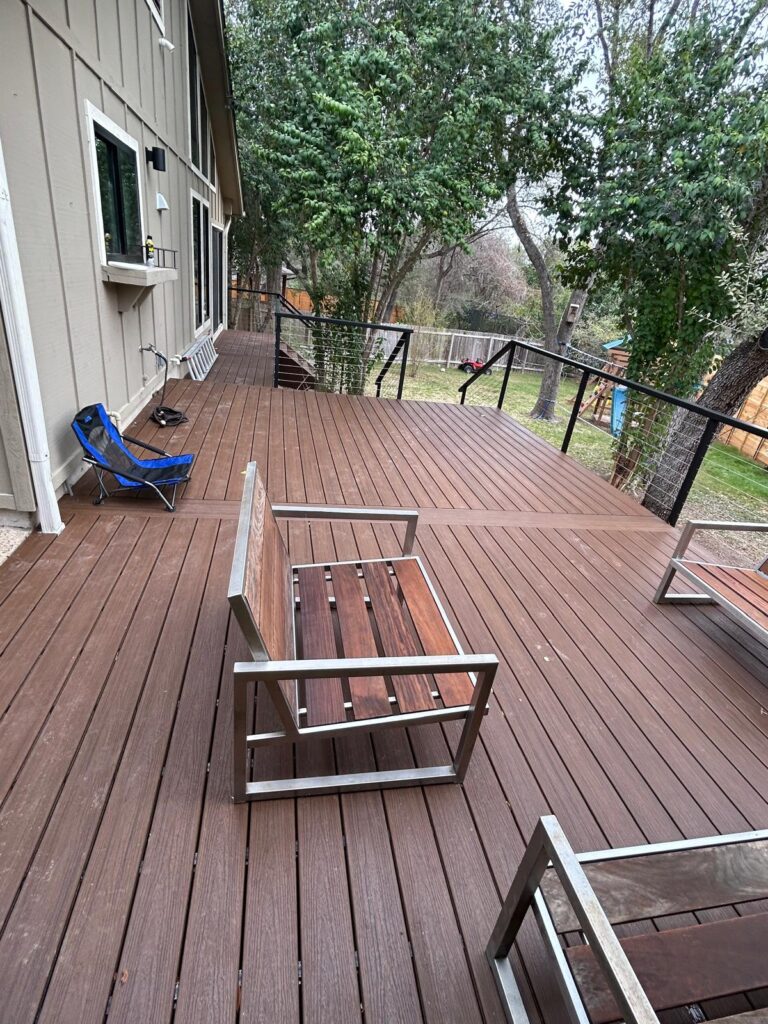
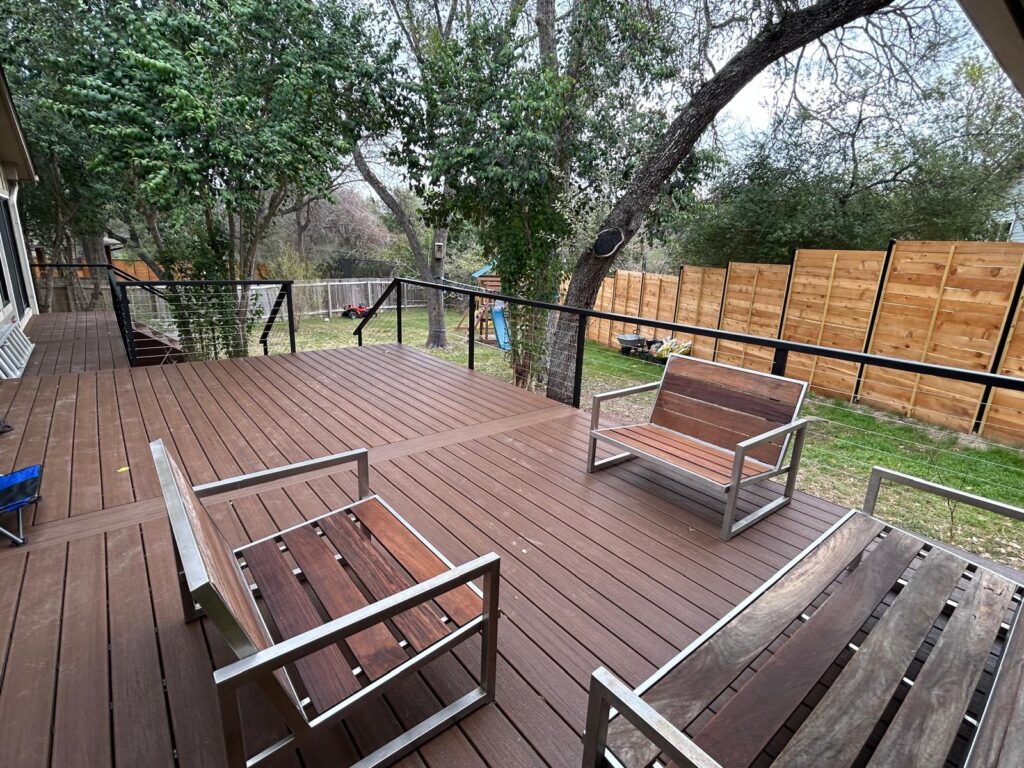
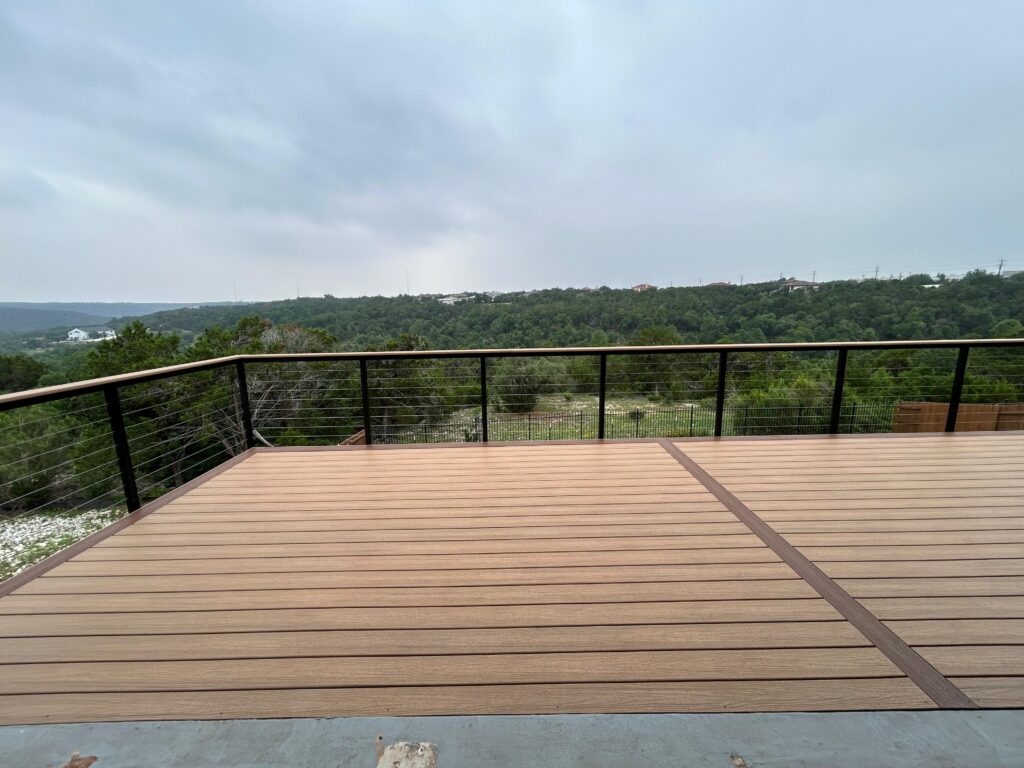
Recent Green Hill Projects
How It Works
Four steps, all built around one question: is your frame ready for composite?
A project manager pulls a few boards if needed, checks joist spacing, moisture, rot, termite activity, ledger attachment and footings, and tells you plainly whether resurfacing makes sense.
We walk through Trex Transcend, Enhance and Select colors, board direction, border style and railing options, then confirm the joist spacing and blocking your chosen layout requires.
Old decking, fasteners and railings come off and are hauled away. We repair or add joists, install blocking, apply joist tape and verify the frame is flat before boards go down.
Boards, borders, stairs and railings are installed to the manufacturer's gapping and fastening instructions. We finish with a walk-through and explain simple care for your new surface.
Built for Central Texas
Central Texas is hard on deck frames in ways that aren't always visible from the top. Termites work quietly in joists near the ground, live oak shade keeps some decks damp for days after a storm, and expansive clay east of MoPac can shift footings enough to throw a frame out of level. Composite boards telegraph every dip and crown in the joists below, so we look for these problems before recommending resurfacing instead of discovering them halfway through.
Heat matters too. Composite expands and contracts with temperature, and a board installed on a cool morning will be longer by mid-afternoon in August. We follow each manufacturer's gapping guidance for end and edge spacing, keep boards from butting tight against the house and posts, and use fastening that allows movement. If your neighborhood has an HOA, as many do in Circle C and Avery Ranch, we can supply the material samples and drawings reviewers typically ask for.
FAQ
Often, yes, if the frame is structurally sound. We check joists, beams, posts, ledger and footings for rot, termite damage and movement, then confirm the joist spacing meets the composite manufacturer's requirements. If spacing is too wide, we can add joists. If the structure itself is failing, we'll recommend a full replacement instead and explain why.
Resurfacing doesn't make sense when the framing is rotted, termite-damaged, undersized or poorly attached to the house, or when footings have shifted on clay soil. It's also a poor fit if you want a different deck shape, height or size. Installing composite on a failing frame just puts long-lasting boards on a short-lived structure.
Most composite boards typically require joists at 16 inches on center when boards run perpendicular to the joists, and closer spacing, often 12 inches, for diagonal layouts. Many older wood decks were framed at 24 inches. Requirements vary by product line, so we confirm against the install guide for the specific board you choose.
Joist tape is a butyl or similar membrane applied to the tops of joists and beams before decking goes down. It sheds water away from fastener holes and the top edge of the wood, where rot usually starts. On a resurfacing job it's especially worthwhile, because the whole goal is to make reused framing last.
Yes, when installed correctly. Hidden clips are engineered for grooved composite boards and hold them firmly to each joist while setting consistent gaps for drainage and thermal movement. They leave the surface free of screw heads. Perimeter and stair boards are usually face-fastened with color-matched screws, which is standard practice and nearly invisible.
It depends on the scope and your jurisdiction. Replacing decking alone may be treated differently than structural repairs or new railings, and rules vary between cities. We build to the adopted building code and guide you through permitting where it's required, whether you're in Austin, Round Rock, Cedar Park or elsewhere in our service area.
Get Started
Schedule a free on-site framing inspection, and we'll tell you honestly whether re-decking or full replacement is right. Call (737) 529-4322, Sunday through Friday, 9am to 5pm.
Walk your yard with a project manager, get design ideas and a clear quote. No obligation.
Book my estimate →